A portfolio review should reduce uncertainty, not merely display a collection of projects. Dayharbor separates attention, delivery, schedule, financials, and people so the group can ask one kind of question at a time and still move directly to the underlying project or task.
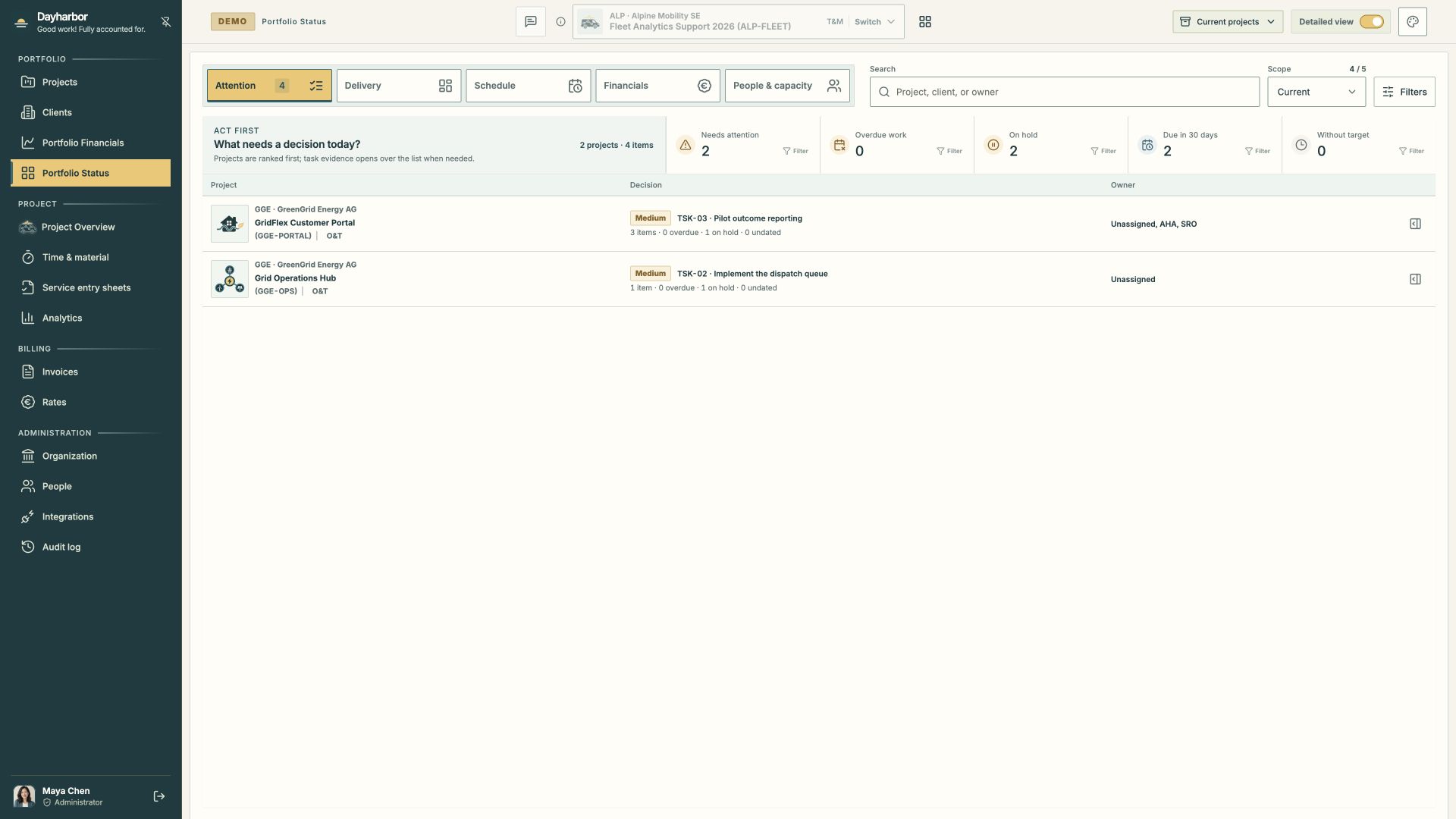
This real capture from the fictional Aurora Studio demo organization shows the Attention view. Projects are ranked before individual task evidence, so the meeting begins with business context rather than an undifferentiated task list.
Prepare the review before the meeting
The quality of a portfolio review depends on project hygiene. Ask project leads to update statuses, target dates, assignments, planned effort, tracked effort, and publication decisions before the meeting. A stale task may create a convincing but false signal.
Use the project scope control to decide whether archived work belongs in the discussion. Keep the normal review on current projects. Bring archived projects back only for a deliberate retrospective, financial reconciliation, or restoration decision.
Agree on a review horizon. “Due soon” should mean the same thing to every participant. The built-in attention view highlights overdue work, held items, work due within 30 days, and tasks without a target. Teams can add their own operating rule, such as reviewing capacity for the next six weeks.
Start with Attention
Attention is the opening agenda. It answers: Where is an explicit decision more valuable than another status update?
Read each row from left to right:
- Project supplies the client and commercial context.
- Decision identifies the leading task or issue and summarizes related signals.
- Owner shows who can move the work, including unassigned effort.
- Review opens the project’s evidence without losing the portfolio context.
Do not resolve a signal by changing a status simply to make the dashboard quiet. Open the task, read its purpose, scope, acceptance evidence, schedule, assignment, source context, and conversation. Then record the decision where the work lives.
Typical outcomes are: appoint an owner, change a target date, split or move work, put an item on hold with a reason, reopen completed work, update scope, resolve a dependency, or accept that no change is required.
Read Delivery as flow, not as a score
The delivery view groups current work by status and completion. A completion percentage is useful only when the plan is current and the tasks are meaningful units. Three completed trivial tasks do not automatically outweigh one critical held task.
Look for flow patterns:
- many items in progress with few completions;
- completed work that lacks acceptance evidence;
- cancelled or moved history that changes the interpretation of current scope;
- objectives whose roll-up status does not match the story told by their tasks;
- unassigned planned effort that makes a target implausible.
Use the percentage as a prompt. The underlying objective and task records remain the evidence.
Use Schedule to discuss commitments
Schedule should answer what is late, what is next, and where the plan has gaps. Check overdue tasks first, then near-term commitments, then missing dates. A missing target is not always an error—discovery work may legitimately be unscheduled—but it should be a conscious choice.
Dayharbor derives objective spans from visible task dates and presents a continuous timeline. When dates overlap, the visualization helps expose coordination risk; it does not decide whether parallel delivery is feasible. Confirm dependencies with the people doing the work.
Separate financial questions from delivery questions
Open Financials when the group is ready to discuss commercial position: planned value, approved budget, invoiced totals, unbilled work, purchase-order capacity, and other billing-readiness signals. Do not give every participant financial access merely because the portfolio meeting covers delivery. Financial capabilities remain independent and the server omits data that a user may not see.
For planned projects, compare calculated task value, approved budget, and invoiced balance. For time-and-material projects, compare recorded, billable, invoiced, unbilled, excluded, and conflicted work. A conflict or missing rate is an evidence issue, not just a number to adjust.
Use People & capacity to test feasibility
Capacity views make assignment risk visible across projects. Look for people who carry too much near-term work, important work with no owner, and plans that depend on a person who is unavailable. Weekly capacity is a planning aid, not a timesheet quota. Discuss actual constraints such as leave, specialist availability, external dependencies, and the difference between assigned effort and calendar time.
Job titles describe project responsibility; they do not grant permission. Keep that distinction intact when changing assignments during the review.
End with decisions and follow-through
A useful review produces a short decision list. For each decision, record:
- the project and affected objective or task;
- the agreed change;
- the responsible person;
- the date or condition for the next review;
- any client publication or conversation needed.
Make the change in Dayharbor during the meeting when practical. Successful audited changes create history, and project-owned changes create a project revision, so the next review can distinguish a new fact from a memory of what someone thought changed.
Finish by returning to Attention. The count does not need to reach zero. The goal is that every visible signal has an owner, a decision, or an explicit reason to remain.
For the evidence behind the portfolio signals, continue with planning objectives and tasks, reviewing time-and-material activity, and explaining changes through revisions.